Noam Sheiber at The New Republic identifies Governor Deval Patrick's 2010 campaign as the model Obama and his aides are hoping will lead to his re-election in 2012. Interesting:
Of all the historical analogies urged on Obama following November’s drubbing—Truman in ’48, Reagan after ’82, Clinton after ’94—the one the White House has opted for is easily the most obscure. That would be Patrick in ’10—as in Deval Patrick, the recently re-elected governor of Massachusetts. Months after Patrick signed the state’s first sales-tax hike in 33 years, political chatterers gave him little chance of surviving to a second term. Not only did he face the same foul, anti-incumbent mood that elected Scott Brown, he’d drawn an attractive GOP candidate in businessman Charlie Baker.
Patrick’s handlers recommended that he distance himself from liberals in the state legislature—and, above all, downplay the tax increase. The governor overruled them. His first commercialhighlighted the “combination of deep cuts and new revenue” he’d accepted to close the state’s budget shortfall. “He all but said, ‘I raised taxes.’ Jesus Christ,” recalls one still-traumatized adviser. “He thought the way to do it was to be true to what he ran on [in 2006]”—the belief that voters will support someone who levels with them, even if they don’t love every decision. In the end, Patrick and his “politics of conviction” won by a comfortable seven-point margin.
"How did Democrats get a deal like that? Ezra Klein's source confirms what I speculated without any information -- Republicans love them some rich folk. They're willing to bargain away a lot to help the very rich:
For one thing, the things [Republicans] wanted were things they really, really wanted. A number of sources with direct knowledge of the negotiations have fingered the estate tax as the major player in the size of the deal. 'Republicans were extremely eager to get benefits for the top tenth of a percent of Americans,' says one senior administration official."
A friend of mine wondered on Facebook whether the Republicans feel bad for the beating they are administering to Obama right now. If this were Little League we might have to enforce the mercy rule.
I always imagined I would be Obama's last defender. It still frustrates me that the left has not embraced the immense challenge and accomplishment the passage of health care reform was and is.
However the current debate over tax cuts and unemployment compensation has me contemplating whether or not to jump ship. I remarked to my friend that Obama's skills as a politician seem to be regressing as he gains more experience. He appears to be the Benjamin Button of politicians.
Thinking back to the primary against Hillary Clinton it is still shocking that Obama was able to defeat the most popular, powerful and effective political family in modern Democratic politics. It seemed that it was Bill and Hillary, especially Bill, who seemed to stumble and bungle the politics of the primary. Who can forget Bill's attempted racial belittling of Obama's victory in South Carolina. It seemed the old pro had lost his touch and a new superstar was born.
But Obama's current weakness started to become apparent during the stimulus debate at the beginning of his term. After much publicized wining and dining of conservatives Obama began the debate over the stimulus bill with a good faith nod to Republicans by including $350 billion in tax cuts and credits in the $900 billion stimulus plan. He was rewarded with an astonishing zero Republican votes in the House and three in the Senate. One of those three, Arlen Specter, was driven out of his party as a result.
This one-way negotiation strategy continued into the health care debate which was nearly derailed when Obama and Senate Democrats let the infamous "Gang of Six" drag negotiations on for an entire summer while Tea Party activists sabotaged the debate in town halls throughout the country. Obama's decision to go all in after the devastating Scott Brown election is still maybe his finest moment and may make all his smaller failures moot in the long run.
Now after the midterm elections Obama appears to letting Republicans fight to protect tax cuts for millionaires while simultaneously cutting off benefits for the those struggling with unemployment. Obama's response? A pathetic attempt at pandering to the deficit hawks with an unsollicited proposal to freeze federal employee pay. A proposal that gets him nothing in return from the Republcians, will fail as a public relations ploy, and will actually do nothing to address the deficit.
When is he going to take a stand? When is he going to pick a fight to illustrate the differences between his priorities and Republican priorities? If the contrast between tax cuts and unemployment insurance does not provide this opportunity I'm not sure what will.
Ted Strickland, former governor of Ohio, and Paul Begala, former aide to President Clinton, agree.
But his frustration was evident as the discussion progressed. Talking, unprompted, about the debate over the expiring Bush tax cuts, Strickland said he was dumbfounded at the party's inability to sell the idea that the rates for the wealthy should be allowed to expire.
"I mean, if we can't win that argument we might as well just fold up," he said. "These people are saying we are going to insist on tax cuts for the richest people in the country and we don't care if they are paid for, and we don't think it is a problem if it contributes to the deficit, but we are not going to vote to extend unemployment benefits to working people if they aren't paid for because they contribute to the deficit. I mean, what is wrong with that? How can it be more clear?"
Here is Paul Begala begging Obama to stop making unilateral concessions to Republicans. The impetus for his comments here was Obama's announcement he would be freezing federal workers pay.
My only hope is that Obama is playing rope-a-dope with the Republicans, feigning weakness to entice the GOP to overreach, and then using their aggression to his advantage. The confluence of the tax cuts/unemployment insurance debates is the time to start fighting back.
The handwringing over the results of the midterm elections continues unabated. Every pundit is offering their analysis and advice to President Obama on how to turn around his Presidency. Pundits recommend that he needs to demonstrate "leadership" or be "bipartisan" or "connect" to the American people. And right wing pundits of course demand that he adopt a conservative ideology.
People seem determined to ignore the one variable that explains it all, the performance of the economy. Probably because that explanation is boring and can't fill up the 24 hours of blathering that is required for FOX and MSNBC programming.
My conviction that the economy explains almost everything in our current political environment was confirmed when I read the Wikipedia summary of the final chapter of CNN's Cold War documentary while preparing for my World History class. This statement about President George H.W. Bush really struck me:
"The Soviet Union ends on 25 December 1991, and in his Christmas Day address Bush announces the Cold War is over."
George Bush presided over the country when it's mortal ideological enemy of 50 years fell AND managed the armed forces to a total and convincing victory over Iraq, the first major successful military operation since Vietnam, and he still convincingly lost the 1992 election to Bill Clinton. When I think about that election result it is a stunning event? Of course Bill Clinton's most famous slogan from the '92 campaign says it best, "It's the economy, stupid."
Political scientist have convincingly demonstrated the overwhelming relationship between the economy and Presidential re-election rates. It just seems pundits don't want political scientists to reveal that all the endless white noise on TV is useless and wrong.
So when someone suggests that Obama needs to do this or that to win back the American people remember that that person is probably just advancing their own personal agenda by disguising it as sincere advice designed to help the President.
I am currently showing my AP Government juniors Bill Moyer's documentary on Iran-Contra and the CIA's role in Latin America during the Cold War called "The Secret Government." The premise of the documentary is that there has been a nefarious secret government, controlled by the CIA, acting on behalf of the American people without their knowledge. The implication of the documentary is that there would be outrage if people knew about these actions by our government.
One average citizen interviewed in the documentary concludes that he now assumes that this type of criminality is going on all the time and the only difference about Iran-Contra is that they actually got caught. This may not be an unreasonable conclusion but I believe the really scary conclusion is that the types of outrageous crimes that used to be done in secret that Moyer's documents are now simply done out in the open. So what is the reaction of the American people? It seems to be a collective yawn.
The evidence of the crimes that are carried out in our names, the modern equivelents of Iran-Contra or the overthrow of Mossedeq in Iran or the overthrow of in Guatemala, are right in front of our noses such as:
1) The United States has admitted to torturing people, over 100 in total, to their death (see also Glenn Greenwald's post on the topic):
More than 100 detainees have died in U.S. custody in Guantánamo, Afghanistan, and Iraq. The U.S. military itself called 34 of these confirmed or suspected homicides. This is one of them: a 47 year-old Iraqi man whose autopsy report concludes “The severe blunt force injuries, the hanging position, the obstruction of the oral cavity with a gag contributed to this individual's death. The manner of death is homicide.”
2) Rendition of people to other countries to be tortured:
3) The elimination of habeas corpus, the basis of English Common Law:
Luckily the Supreme Court stopped this particular egregious power grab in the case Boumediene v. Bush:
4) The killing of civilians by unmaned drones controlled by the military and CIA:
Some of you might be inclined to dismiss this as an abberation of the American goverment which only occured because of weak leadership by George W. Bush that allowed rogue advisers such as Cheney, Rumsfeld, Rove, Wolfowitz, etc to run roughshod over the Constitution. Unfortunately it appears President Obama is continuing many of these crimes in the name of the American people:
Glenn Greenwald captures the disappointment with Obama's continuation of Bush anti civil liberties record despite campaign promises to the contrary:
Here's how the NYT describes the article on its front page:
As a candidate for president, Barack Obama offered himself as a clear alternative to Bush-era anti-terrorism policies. Governing has proven muddier.
Both articles quote the hardest-core Bush supporters as heaping praise on Obama for what he has done in the area of "national security," terrorism and civil liberties ("Pete Wehner, a member of Karl Rove’s staff in the Bush White House [and a current National Review writer] applauded several of Mr. Obama’s decisions this week"). Indeed, all week long, and even before that, the greatest enthusiasm for Obama's decisions on so-called "terrorism policies" and civil liberties (with some important exceptions) has been found in the pages of The Weekly Standard and National Review.
One aspect of Obama's Presidency to date that is frustrating is their inability and/or unwillingness to co-opt Republican issues and turn them in to advantages for Obama and the Democrats. Both Bill Clinton and Karl Rove perfected this political strategy. Clinton took on Republicans on issues like the budget deficit and welfare. Karl Rove attacked the military credentials of both John Kerry and Max Cleland issues that were their supposed strengths.
I think these opportunities exist for Barack Obama but he has yet to press his potential advantage to date. Three examples spring to mind:
1) The Stimulus
The stimulus is viewed by many to be too aggressive and expensive. Just look at these numbers:
Despite the unpopularity of the stimulus many independent analysts believe it kept the Great Recession from being significantly worse. See the following two graphs.
GDP and unemployment numbers in the abstract probably won't gain much political traction but contrasting the loss of jobs under Bush versus Obama might bring the differences in sharper and more effective relief.
The Obama Administration's lack of aggression in promoting the success of the stimulus can be forgiven because unemployment is still poor. The people you are trying to persuade, those that are suffering, will find little solace if you try to tell them, "Hey, it could be worse, your neighbor could be out of work too." And to make matters worse the neighbor is not necessarily going to connect the stimulus to their ability to keep their job.
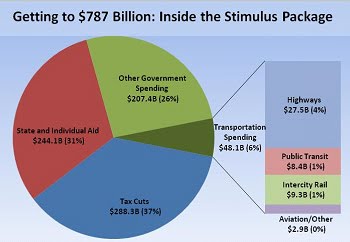
So the stimulus might be a tough sell no matter its merits, but an easier sell for the Obama Administration could be the issue that is synonymous with the right, taxes.
2) Taxes
How many people know that almost forty percent of the stimulus was tax cuts? Here is the breakdown of the $800 billion.
Their was a meek attempt on tax day, April 15, to bring attention to this fact. This article from The Huffington Post looks at the numbers:
After all, neutral economists insist that, under the Obama administration, the overwhelming likelihood is that your tax burden has gone down, not up. Even conservative economic analysts acknowledge that there really is no basis for middle- and working-class Americans to believe that they're suddenly paying more. "The only tax I think that has been put in place so far is an increase in the federal cigarette tax. I can't think of another Obama tax that has gone in place so far," said Chris Edwards, Director of Tax Policy Studies at the conservative Cato Institute.
3) TARP
TARP, the Temporary Asset Relief Program, might be the most unpopular policy of all the measures designed to prop up the economy. As Talking Points Memo recently reported,
As unpopular government initiatives go, the financial bailout would seem to rank somewhere up there between Prohibition and the Stamp Act.
But the $700 billion estimated price tag now seems to be a huge overestimate...
But it now seems clear that that $700 billion figure cited as the cost of the TARP alone was way too high. Pro Publica records that of $536.3 billion that the Treasury has dispersed to date on the TARP and the programs to rescue Fannie and Freddie, $216.8 billion has already been returned, either through banks paying the money back, or through dividends generated. That still leaves $319.5 billion outstanding, but most estimates are that as the health of the financial sector continues to improve, much of that figure too will return to the government's coffers. Indeed, last month, the Treasury Department offered an estimate of its own. The TARP program will end costing about $117 billion, Tim Geithner forecast. Help for Fannie and Freddie will likely add about $85 billion more. But those losses will be partially offset by expected gains of $115 billion from the Fed's programs. That comes out to a final cost to taxpayers of $87 billion.
However much it costs, the most important issue is whether or not it worked. Even skeptics are coming around:
That hasn't happened, and experts of various stripes -- even many who initially were doubtful -- credit the bailout for that. Barry Eichengreen, a professor of political science and economics at UC Berkeley, and a left-leaning foe of the big banks, wrote earlier this year that the TARP "enabled the banks to earn their way back to solvency," and "prevented the financial system from falling off a cliff." And Tyler Cowen, a professor of economics at George Mason and a libertarian, also was skeptical at first but has conceded that "yes, the bailouts were a good idea," adding that without them, "we would have had many more failed banks, very strong deflationary pressures, a stronger seize-up in credit markets than what we had, and a climate of sheer political and economic panic."
However if one lesson was learned about Obama during the drawn out primary is that he and his staff are masters at the long game. It is possible that the Administration is keeping its powder dry realizing that the power of these messages will be more effective if they are used sparingly closer to the election when people are paying attention.
A strange paradox of American politics is that the least democratic branch of the government, the Supreme Court, is the most popular and the most democratic, Congress, is the least popular. This data from Gallup illustrates this point:
Despite people's disdain for Congress incumbents are re-elected at very high levels:
The answer to this riddle lies in the old axiom: "People hate Congress but love their Congressman."
I was reminded of these paradoxes when Andrew Sullivan highlighted two writer's theories as to what is necessary to motivate the federal government to reign in the nation's deficit and debt? This crisis is becoming impossible to ignore as our debt to GDP ratio is approaching World War II levels.
There’s a short list of big, successful deficit-reduction efforts, and they all had at least two of these three elements in common: 1) The deficit situation had become dire or embarrassing, or both. 2) The president committed to the effort and/or signaled he’d give up a key pledge to get a deal. 3) The opposing party was willing to negotiate away a piece of its bedrock position to get a deal.
What the three episodes [Hager] cites (1982, 1990, 1993) have in common was that in each case, the president's economic team told him that the problem was likely to have real, immediate effects on the economy, effects that would show up before the next election. In each case, that seems to have been both necessary and sufficient. Hager does include presidential involvement as one of his three conditions, but I'm making a slightly different claim: presidents will care about deficit reduction when they have an electoral incentive to care about it, and once they are on board, Congress gives it them to them.
I would argue that American's disgust with Congress is intimately tied to it's inability to get the budget under control. When you have the darling of the far right, Dick Cheney a supposed champion of fiscal conservatism, declare "Reagan proved deficits don't matter" you know you have a problem.
There are several forces at work that are going to bring the deficit to the forefront of the nation's political debate: deficits that are triggering World War II level GDP/debt ratios, no savings from a World War II military demobilization likely, and an improving economy which will allow people to focus on other issues. Hager's thesis is going to be put to the test because if this fiscal situation isn't embarassing for the political elites than nothing is.
If Hager is wrong and Bernstein is right, that it takes fear of not getting re-elected and not just potential embarrassment to create the political will to reign in deficits, I am worried. The political message being sent by American's is that they want balanced budgets but the evidence is not there that they support cutting the necessary programs.
However it is possible that President's take the above graph too seriously. With President's approval ratings double to triple that of Congress it is possible the President could take on Congress on the spending issue. The reason they do not is that I think they are psychologically beaten by the campaign process.
Once in office presidents might be able to get away with cutting popular programs such as Medicare, Social Security or Defense but there is no way possible they could win an election urging these unpopular cuts. After kissing up to every special interest group and constituency during the campaign it is understandable that they might actually come to internalize their pandering. As a result we get tax cuts and increased spending such as health care because they tell themselves that is what the people want.
If we are to see a President attempt this high risk gamble it will most likely happen during a second term. I hope Obama is the first President to get a chance.
In my last post I argued that Reagan and Bush were Keynesians whether they admit it or not.
Barack Obama on the other hand probably would not shy away from the Keynesian label. Obama's $900 billion stimulus, designed to get us out of the Great Recession, is right out of the Keynesian playbook.
With unemployment still hovering around 9.7% many in this country are not convinced that his policies have worked.
Just today quarter one GDP numbers came out and they were good but not great. The Bureau of Labor Statistics stated that the economy grew 3.2% . This number would be great under normal circumstances but these are not normal times. The country really needs to experience growth in the 5 to 6% range to fully recover from the past two years.
But we should be thankful that even the modest recovery we are experiencing was made possible by Obama's stimulus and the economic theories of Keynes.
Democrats and Republicans will argue this point but I would rather look at independent analysts that are paid to create accurate data for clients instead of listening to partisan spin doctors.
The following graph shows the estimates from three different Wall Street analysts on what the economy has done with the stimulus and what it would have done without.
It seems clear that doing nothing would have been disastrous. Ultimately though the American people will render their judgment over the next several elections.




 Posts
Posts


